
A sketch pad is bought on three numbers: the weight of the paper, the number of sheets, and the way the block is bound. Two of those decide what the pad can do. The third decides who buys it — and it is the one most catalogue entries leave out.
This guide is written for the buyer who has to put a sketch pad range on a shelf and defend it: school suppliers, art-material distributors and studio retailers. It covers how weight and sheet count combine into the thing you actually ship, what each binding construction does to the way a pad is used, and what has to be settled on paper before a quotation is worth reading.
Weight and sheet count are two halves of one specification
Paper weight in gsm describes one sheet. It says nothing about the pad. The pad is the pair — weight multiplied by sheet count — which is the block of paper you are storing, shipping and pricing.
Our own range makes the point better than an argument does. Five pads, all built in A3, A4 and A5:
Pad in the range Paper weight Sheets Weight × sheets
Beige artist sketchbook pad 160gsm 30 4,800
Professional sketch pad 160gsm 24 3,840
Watercolour drawing pad, wood pulp 200gsm 30 6,000
Watercolour drawing pad, mixed cotton 300gsm 15 4,500
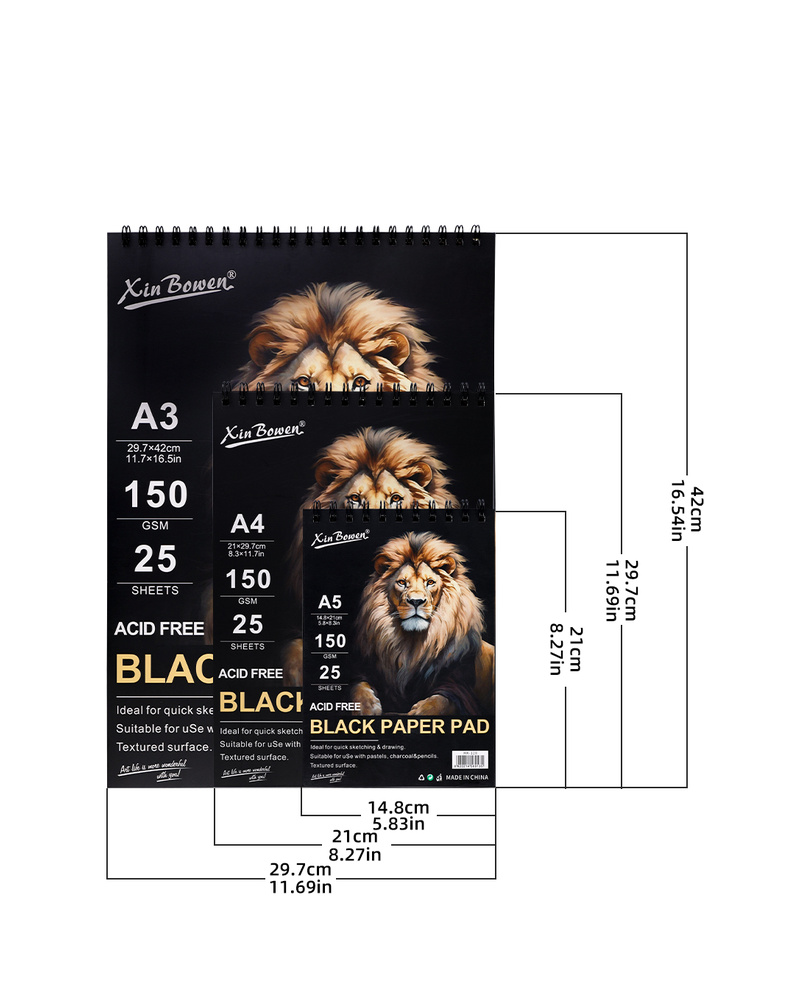
Black paper pad for sketch drawing 150gsm 25 3,750
Read the first and fourth rows together. The 300gsm pad carries nearly double the paper weight per sheet — and almost exactly the same block as the 160gsm pad, because it holds half the sheets. A buyer who specifies 300gsm and expects a thicker sketch book than a 160gsm sketchbook has read one number instead of two.
Across the range the block runs from 3,750 to 6,000, a difference of about 60% between pads that look identical on a shelf. For a school account that ratio is a budget line: lower weight with more sheets buys more drawing surfaces per unit, higher weight with fewer sheets buys sturdier pages. Neither is better. They answer different questions, and the buyer is the person who has to know which question the account is asking.
Binding decides which buyer the pad serves
A pad is bound to solve one problem: what happens to a page while someone is working on it. There are three constructions a buyer is usually offered, and a range of any width covers all three.
Ring binding runs wire rings through punched holes at the edge. The pad opens flat and stays flat, which matters when work crosses the centre of a spread, and a sheet can be lifted out of the block without cutting anything. Our ring binding sketchbook pad is built in A3, A4 and A5 for exactly that reason: page removal is the point of the format, not a side effect.
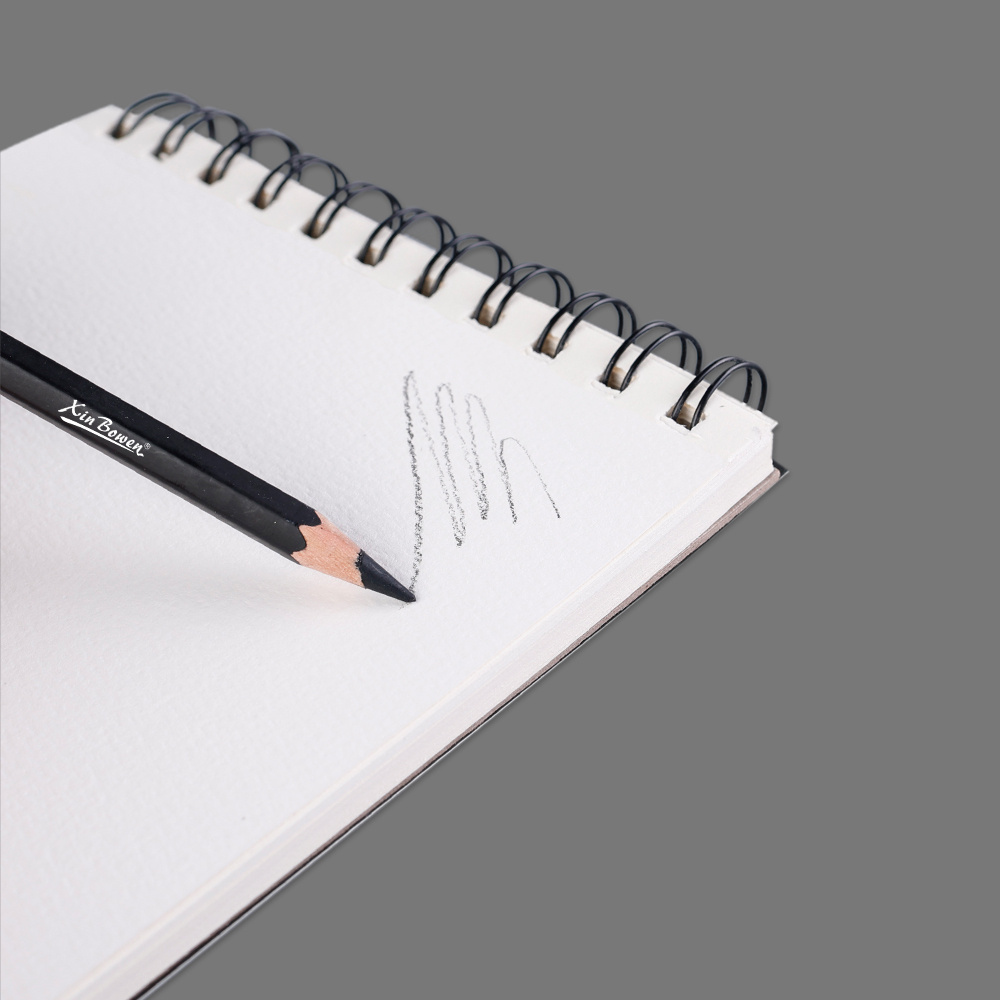
Spiral binding uses a continuous coil. It also opens flat, and it turns a full 360 degrees, so a pad folds back on itself and can be used standing up. That is the construction for outdoor and urban sketchers, and it is what our spiral bound sketch pad uses at A3, A4 and A5 — including the 150gsm black paper version for pastel, gel pen and charcoal work.
A pad with a rigid backing board carries its own support. There is no table requirement and no second board to pack. Our professional sketch pad — 160gsm drawing paper, 24 sheets, A3 to A5 — is built that way, and it is the format for classroom practice where the desk surface cannot be trusted.
Worth holding on to the distinction: ring binding and spiral binding are about flatness and page removal, a backing board is about working anywhere. A supplier who can offer only one of the three is not offering a range, and the account will buy the other formats elsewhere.
A5, A4 and A3 are one range, not three products
One pad in three sizes is three listings, three cartons, three spec sheets, three reorders. Run them as a set and the size question stops being a negotiation: the account gets the same paper in the pad that fits a bag and the pad that fits a desk, and students’ work stays consistent across both.
That is a stocking decision rather than a marketing one. A distributor listing only the middle size loses the school tender that specifies a full set. A retailer that buys all three from one supplier keeps one specification sheet, one paper colour and one quality conversation — which is most of the running cost of a paper line.
Spelling and word order travel badly, and they cost sales before a pad is even opened. The same product is listed as a watercolor book in one market and a watercolour book in another. It is searched for as a drawing sketch pad by one buyer and as sketch pad drawing by the next. A school asks for an a4 sketch book, a parent asks for a sketch pad a5, and a studio asks for a sketch pad a3 — three ways of asking for the same three sizes of the same pad. Pick one spelling and one phrasing per listing, and the product stops competing with itself in search.
The specification sheet to send a supplier
A request for a sketch book quote gets a price for something. A specification gets a price for your thing. Four lines are the minimum — weight, sheet count, size, binding — and the two people most often leave out are sheet count and binding, which are the two that decide whether the container matches the sample.
Pad in the range Paper Sheets Sizes Binding
Beige artist sketchbook pad 160gsm beige 30 A3 / A4 / A5 ring binding
Professional sketch pad 160gsm white sketch paper 24 A3 / A4 / A5 rigid backing board
Watercolour drawing pad, wood pulp 200gsm 30 A3 / A4 / A5 paper pad
Watercolour drawing pad, mixed cotton 300gsm 15 A3 / A4 / A5 paper pad
Black paper pad for sketch drawing 150gsm black, acid-free 25 A3 / A4 / A5 spiral bound
Add two more lines if the account will run for years: the paper colour, and whether the back board is part of the product or part of the packing. Both are the source of the complaint that arrives eight months later, when the second order is noticeably creamier than the first.
What fails after the container lands
Most pad complaints are not defects. They are the predictable result of one number being chosen without the other.
Edges that wave. A light sheet used with a wet hand, or a thin block left on a shelf, lets the paper move. Weight and block thickness are the control here; packing cannot fix it.
Pages that pull out. A binding is specified for a range of block thicknesses. Keep the binding and raise the sheet count, and the same spine is being asked to hold more than it was built for.
Rings and coils that arrive bent. Ring binding and spiral binding both crush if the carton has nothing rigid above and below the block. That is a packing decision, and it is worth one line on the order.
Colour that drifts between batches. Beige is not a specification. Put the paper colour in writing, keep the approved sample, and compare the next delivery against it.
And the one that costs most: a pad that is correct in every printed number and wrong in the hand. Ask for the physical sample — same paper, same weight, same binding, packed in the same carton.
What to fix before you ask for a quotation
Give the four lines first. Then give the carton, because carton quantity is a design number rather than a shipping detail: it sets how many pads a school can take at once, how the pallet builds, and what the reorder multiple is. The A3 black paper pad ships 25 pads per carton; the 24-sheet professional sketch pad is quoted from a single carton.
Then packing. A sealed block protects paper in transit and on a warehouse shelf, and it is the difference between a pad that arrives ready to sell and one that arrives with dog-eared corners.
Then ask the two questions a catalogue cannot answer: which paper you hold in stock, and the lead time on a repeat order to the same specification. For a school sketch book programme the second question matters more than the first, because the reorder lands in the middle of a term, not at the start of one.
Xin Bowen is a Chinese art-materials manufacturer. Founded in 2008, the company sells to wholesalers and brand agents, to art-supply retailers and to school programmes. The company and its distribution operation are based in Yiwu, Zhejiang, and we run three factories including our art-pigment plant in Ningbo. Sketch pads, drawing paper and watercolour pads sit alongside brushes, paints and canvas in the range we supply to buyers in North America and Europe.
If you are assembling a sketch book range — and you want a sketch book for artists that holds up in a classroom as well as a studio — send us the weight, the sheet count, the size and the binding, plus the market you are selling into. We will quote it item by item with MOQ, carton quantity and lead time included, and we will tell you where a bulk sketch pad order changes the packing.
📩 pm@tengyuanbrush.com | +86 153-3692-1170 (WhatsApp)
👉 https://www.xinbowen.com/contact-us/