
Retailers and distributors encounter a shared hurdle in 2026. Consumers continue to love their hobbies. Yet, many individuals watch their budgets closely before making a purchase. Recent reports from Marketplace point out increased spending on leisure activities. Additionally, Circana’s research regarding private-label shopping habits brings up an important question for art-supply buyers. How can a painting kit feel valuable without stuffing the package with unnecessary items?
For any B2B group, the answer involves more than just slashing expenses. A dependable artist painting tools set must display its intended use plainly. It has to provide a genuine purpose for every single component included. Moreover, it must fulfill the expectations set by the retail shelf or the online listing. This strategy allows a merchant to highlight true worth. They will not need to depend solely on massive item quantities or heavy markdowns.

Why does perceived value matter when hobby spending grows?
Increased enthusiasm for hobbies does not mean buyers forget about costs. A person may wish to purchase art supplies. Even so, they will wonder whether a bundle offers enough practical materials for the price. This scenario presents purchasers with an excellent opportunity. They can highlight worth clearly by offering a defined project, functional components, and precise specifications.
Within private-label initiatives, transparent product details offer shoppers better comparison points than mere cost and piece totals. A painting set can stand out based on its utility. This occurs when the intended activity, the canvas dimensions, and the provided instruments are exceptionally simple to grasp.
How can buyers make value visible in a painting kit?
Initially, figure out what a user ought to achieve using the kit. Complete this step prior to examining pigments, brushes, or boxes. This action does not require a complicated teaching guide. Rather, it involves selecting a straightforward application. Next, verify that the supplies facilitate this job from the initial stroke to the completed piece. This decision provides sourcing, sales, and marketing staffs with a shared baseline.
Start with a project, not a piece count
A project outline can remain quite basic. It could state "paint a small landscape" or "practice color blending on paper." From there, the purchaser can evaluate the provided canvas, the volume of pigment, the mixing tray, and the brushes. They need to determine whether these elements function smoothly as a group. A huge quantity of items does not naturally equal a superior bargain. This holds particularly true when multiple components serve no obvious role.
This approach also assists in clarifying a major distinction. It demonstrates why an acrylic paint set differs from a bulky mixed-media package. One choice could concentrate on a lone medium along with a distinct task. The alternative selection could incorporate sketching implements or additional boards. The ultimate decision ought to align with the intended consumer and the store price. It should never stem from a basic desire to inflate the appearance of every package.
While evaluating an artist painting tools set, request a straightforward inventory list from your vendors. Verify the dimensions, the amounts, and the primary material details for each individual piece. A purchaser must examine this document and define the function of the core elements. They ought to accomplish this task without inventing untrue performance statements.
Compare the cost of a usable experience
The price per unit remains undeniably crucial. Nevertheless, it fails to reveal the entire picture. A pair of packages sharing a comparable cost could supply varying quantities of practical materials. They could feature distinct board dimensions or varied assortments of instruments. A task-oriented assessment allows the staff to evaluate what the consumer can genuinely produce. Simultaneously, this process anchors the economic analysis to actual, quantifiable facts.
Useful questions include:
Does the bundle contain the essential implements required for its declared task?
Are the pigment volumes and board dimensions obvious to the consumer?
Do the brushes possess distinct functions? Or do multiple items fulfill the exact same role?
Will the box shield the materials adequately? Will it achieve this without causing the item to appear unnaturally bulky?
Can the store website present the included items correctly and plainly?
These evaluations provide a paint brush kit or a complete assortment with a highly credible narrative regarding worth. They additionally assist merchandising groups in comparing vendor estimates fairly. Staff members will avoid treating the cheapest figure as the solely significant metric.
What makes a value-focused range credible to B2B buyers?
After establishing the intended application, the item description and the physical prototype must reinforce that identical commitment. Value-oriented terms can generate curiosity. However, they can equally create skepticism. This occurs whenever consumers discover that a crucial measurement, instrument, or volume remained concealed. Consequently, purchasers have to examine the complete proposal. They ought to inspect the merchandise, the packaging, the online entry, and the prototype collectively.
Make specifications easy to compare
Regarding canvas art kits, consistently state the material type along with the precise measurements. If the item includes a stand alongside a board, detail precisely what sits inside the box. Furthermore, display the genuine proportions truthfully. A consumer may ask "which canvas size is best for painting." That individual requires practical context. They do not require an ambiguous assertion claiming a single dimension suits everybody flawlessly. The actual response relies upon the intended project, the sales platform, and the accessible crafting area.
This identical principle governs phrases such as synthetic painting brushes. That specific wording alone fails to inform a purchaser regarding the bristle shape, the dimensions, or the designated application. You have to incorporate the solid facts supplied by the manufacturer. Steer clear of sweeping statements which the technical details fail to back up. Transparent data can cause a reasonably priced collection to appear highly trustworthy. It accomplishes this goal without overstating what the merchandise can actually execute.
Xin Bowen’s inventory features painting tools alongside associated craft supplies. Purchasers are welcome to explore our artist painting tools set collection serving as an excellent foundation for a project outline. Following that step, they can verify the precise parts and technical details suitable for their distinct consumer base.
Keep the product page honest and useful
The product page is a big part of the value proposition. It must show item counts, basic roles, and dimensions clearly. Sometimes shoppers search for terms like “paperpallate” or “transition brush.” In these cases, listings must still use accurate names. They should also explain any unusual terms. Phrases like “best colored pencil set for beginners” and “art supplies for beginners” require precise content details. For canvas buyers, you should address “which canvas size is best for painting.” Also, state the canvas frame thickness when it applies.
Similarly, tags like “best colored pencil set for beginners” or “art supplies for beginners” should not serve as generic labels. Use them only if they truly match the product and the audience. A well-planned assortment can help new painters. It can do this without claiming that one specific kit is perfect for every single learner. For instance, a standard easel might suit certain display needs. However, it must be named and described accurately. It should never be implied if it is absent from the box.
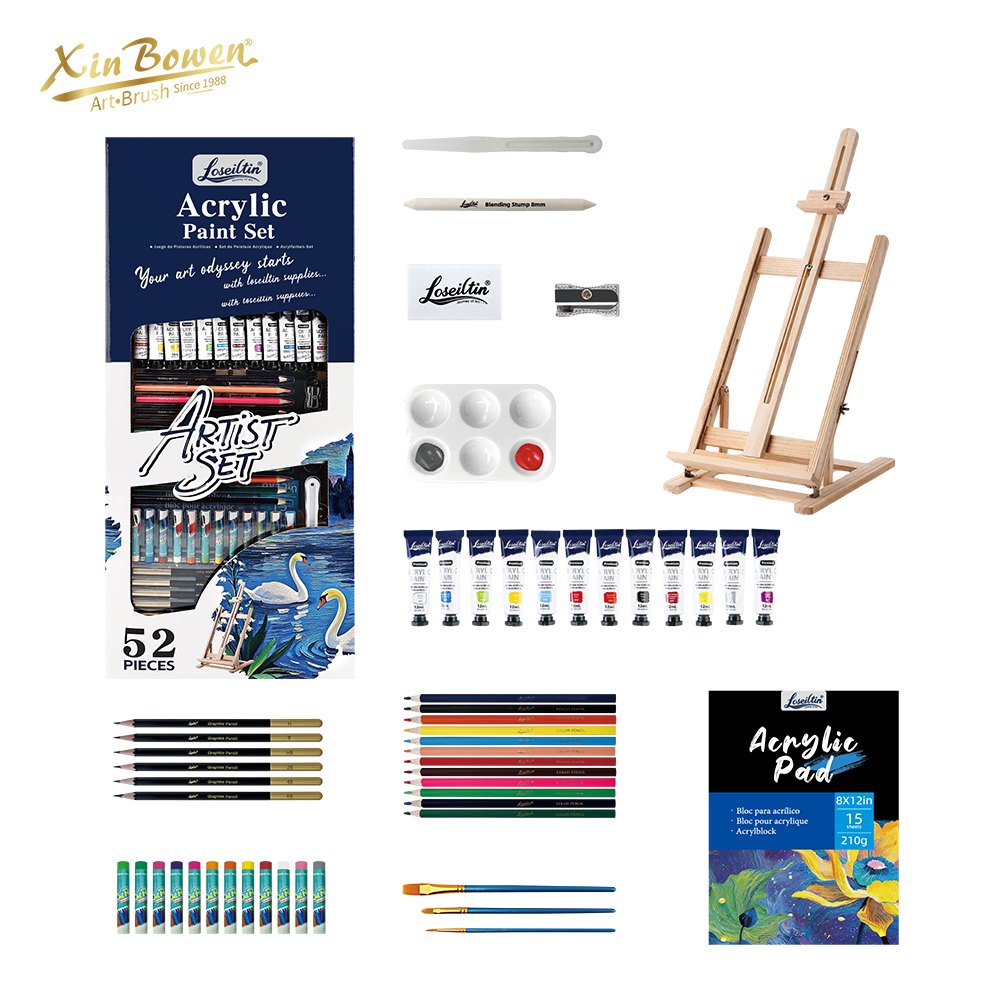
Our products page gives a wider view of the Xin Bowen range. For one helpful reference, our 52-piece acrylic paint set shows a great example. It demonstrates how a painting offer can mix tools and related materials effectively. B2B buyers should review the current product details and a physical sample. They must do this before deciding how a specific format fits their local market.
How can private-label teams protect value through the buying process?
Perceived value is built long before a product ever reaches a store shelf. The initial brief, sample review, artwork, and approved packing list all play a huge role. They determine if the final product truly matches what a customer expects. A strict process makes that alignment much easier to verify. This is especially true when multiple teams work on a new launch.
For a private label art program, buyers can easily prepare a short specification sheet. This document should include:
the target customer and the planned activity;
part names, sizes, quantities, and important material facts;
the retail price target and the required package dimensions;
pictures or text that must match the actual delivered contents;
sample approval stages and any special market requirements.
This is not just useless paperwork. It gives the supplier and the buyer the exact same reference point. They use it when reviewing samples and production details. Xin Bowen offers support across design, production, quality inspection, and packaging coordination. We can discuss customization and project needs through our one-stop service. Meanwhile, buyers must confirm the scope, timing, and specifications for every single order.
Conclusion
Budget-aware shoppers do not always seek the absolute cheapest painting kit. They simply want to understand what they are buying. They want to feel sure that the contents fit the described activity. For B2B buyers, this reality turns value into a product-planning task. You must define the project and compare usable contents. You must state dimensions and quantities clearly. Finally, you must check that the physical sample matches the sales page perfectly. A focused artist painting tools set can prove its worth easily. It does this without useless extras or exaggerated claims. Recent interest in hobbies gives retailers a solid reason to review their product ranges. However, a smart purchasing decision still relies on clear specifications and a trustworthy offer. Xin Bowen works closely with buyers on product options and service support. Ultimately, the final assortment must be built around the customer, the retail channel, and verified product details.
FAQs
Q: What makes a painting kit feel worth its price?
A: A well-defined project, useful parts, accurate dimensions, and honest product details help shoppers judge true value.
Q: Should retailers compare kits by piece count?
A: No, they should not. They must compare the components’ functions, quantities, surface sizes, and alignment with the stated activity.
Q: Can Xin Bowen support private-label painting kits?
A: Yes, we offer full service support for customization discussions. Please confirm all specifications, timing, and order scope with our team.