

Where the Number on the Box Comes From
A 25-piece brush set is not twenty-five brushes. The number on the box is a piece count, and a piece is whatever the seller has decided to count. Open the roll on this one and the contents separate into four lines: twenty-two artist brushes, a single larger paint brush, one palette knife, and the fabric bag that holds them all. The arithmetic is exact: twenty-five.
That definition matters more than it sounds, because almost every disagreement about a brush set starts with two people counting correctly and meaning different things. One counts brushes. One counts tools. The third counts everything that ships. None of them is wrong, and all three can produce a different total from the same carton.
What follows is what this set contains, why each part is there, and how a buyer can verify the count without taking the label’s word for it. The set itself is published in four colourways, and the specification is on the product page: the 25-piece set.
Twenty-Two Brushes, Five Head Shapes
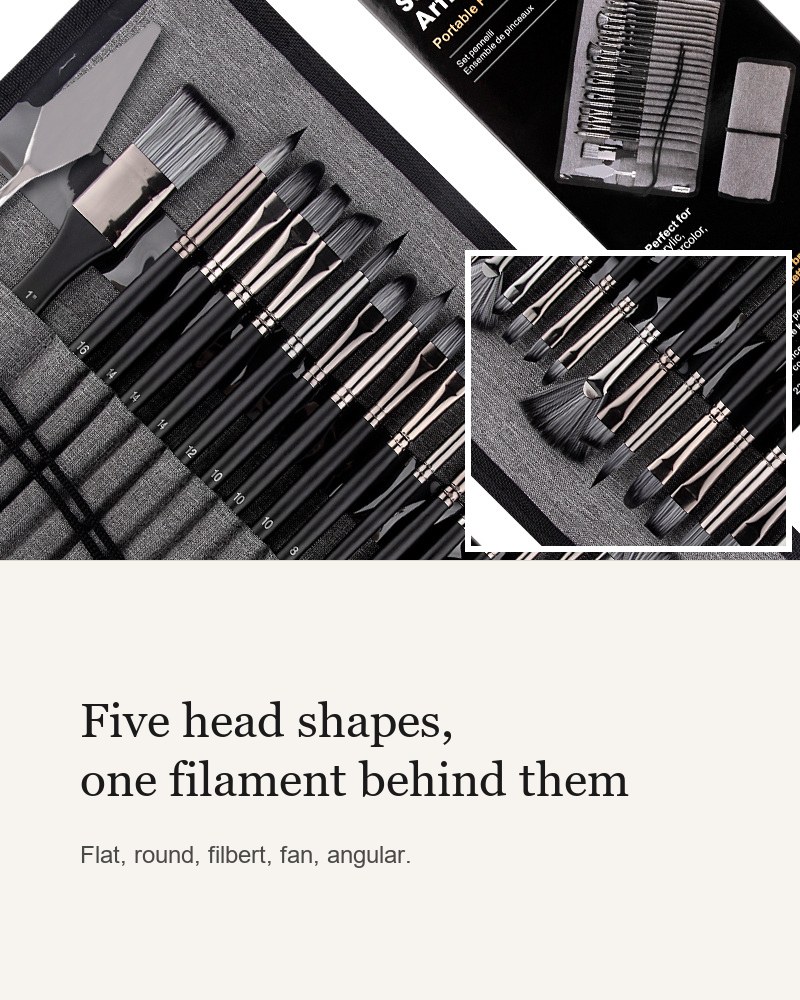
The twenty-two are not twenty-two sizes of one shape. They fall into five families: flat, round, filbert, fan and angular. Each family does a different job on the surface, and the sizes inside each family are what allow one set to cover a full painting rather than a single stroke.
A flat carries paint in a block and cuts a hard edge. A round draws a line and releases a wash. A filbert blends without leaving a squared mark. A fan drags texture. An angular reaches a corner that none of the others can enter cleanly. Five families, and the set is only complete when every one of them is present in more than one size.
Check this first when a set claims a brush count. Twenty-two flat brushes in twenty-two sizes would satisfy the number and fail the purpose. The number is only meaningful when the families behind it are mixed, which is also why the arrangement inside the roll matters: the elastic loops hold the brushes in order, and the handles carry numbers so a buyer can see at a glance whether a family is missing: the brush range.
One Filament Across the Whole Line
The twenty-two brushes in this set share a single filament type: premium nylon, with a modified cross-section that holds water along the length of the filament rather than only at the tip. The same fibre gives spring and flexibility, which normally pull in opposite directions, in one strand.
That single-fibre decision is what makes a set behave as a set. When twenty-two brushes are built from the same filament, a stroke made with the size twelve and a stroke made with the size two feel like the same hand, and a buyer can predict what a new size will do before opening it. When the line is mixed, the behaviour changes from brush to brush and the painter has to relearn the tool in the middle of a picture.
The benefit shows in two media at once. Acrylic asks a brush to carry a load and release it evenly while the film is still workable; watercolour asks it to hold water and give it back slowly. A filament that loads along its length does both jobs without changing tools, which is the reason this set is sold as suitable for acrylic, watercolour and oil.
The Bag Is Counted as a Piece
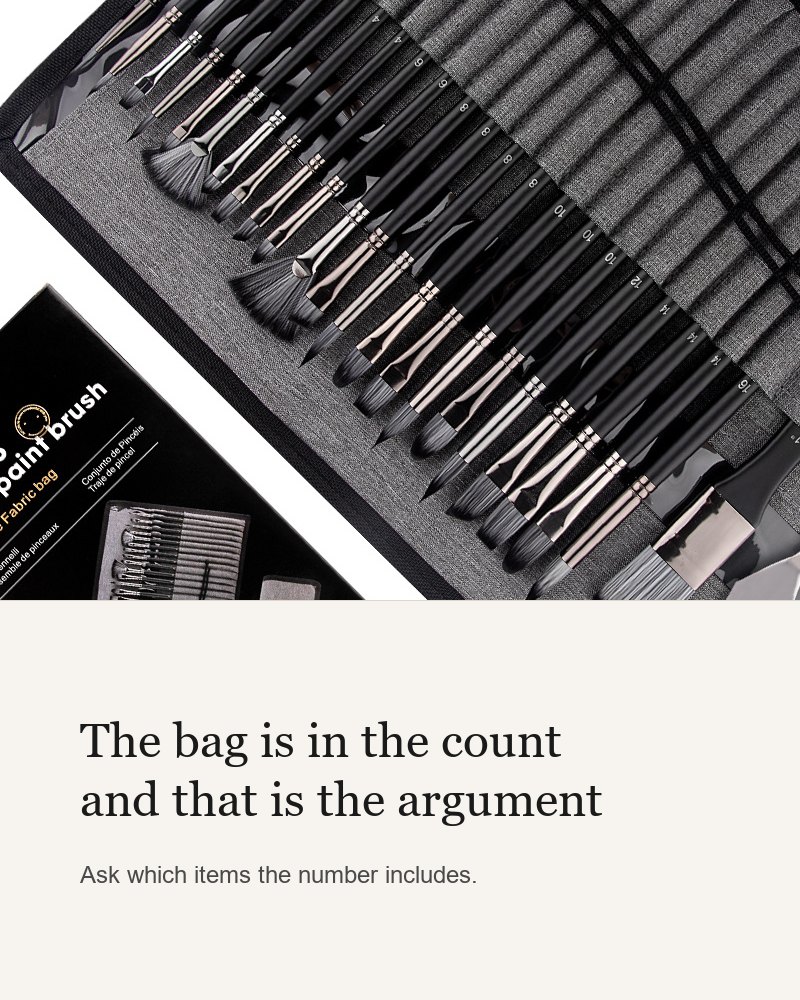
The fabric bag is part of the count. It is a grey roll with elastic loops for the brushes and a zipped pocket on one side, and it is the reason the number reads twenty-five rather than twenty-four.
Some buyers find that irritating, and the irritation is fair: a bag is not a tool. But counting it is not dishonest, as long as the seller says so before the order rather than after. The count on the box is a description of what arrives in the carton, and the bag does arrive in the carton.
What a buyer should take from this is narrower and more useful. If the piece count includes the bag, then the number tells you the size of the shipment, not the size of the toolkit. A set that counts its bag and a set that does not are not comparable on the number alone, which is the whole argument for putting the definition in writing: what actually counts as a piece.
The Knife Is Part of the Kit
The palette knife in this set is the one piece that does not look like the others, and it is the one that makes the set usable without a second purchase. A knife can lift paint from a palette, mix two colours on the surface, scrape a passage back to the ground and lay a flat film that no brush will lay.
One knife is enough for that job. Two would be a different product with a different price and a different purpose, and a buyer who expects two should say so in the brief rather than assume it from a photograph. The specification pages for rigid tools describe the blade and the handle separately: the palette knife.
A Set Checklist You Can Hold Against a Carton
| Component | Count | What to check at goods-in |
|---|---|---|
| Artist brushes, mixed head shapes | 22 | five families present, numbered handles, no two identical sizes filling a slot |
| Larger paint brush | 1 | ferrule seated, no gap at the handle joint |
| Palette knife | 1 | blade straight, handle joint tight |
| Fabric roll bag | 1 | loops stitched through, zip runs the full length |
The table is deliberately dull. It is also the only part of this article that survives contact with a loading dock, because it turns a total into four lines that can be ticked.
What Padding Looks Like When You Unpack
Padding is the practice of reaching a round number with pieces that do not earn their place. It is common, it is not always deliberate, and it has three recognisable shapes.
The first is duplicate sizes. Twenty-two brushes become easy to hit if several of them are the same shape in nearly the same size, which fills the roll and adds nothing to the range. The second is counting packaging as product: a bag, a sleeve, an inner tray, each of which is real but none of which paints. The third is a tool that cannot be used, usually a knife with a blade too thick for the medium or a brush whose ferrule separates on the first wash.
None of these is fraud, and the fix is not suspicion. The fix is to ask which items the count includes, and then to check that each item does something the others cannot. On this set the check is straightforward, because the four lines in the table above are also four distinct jobs.
How to Verify the Count Without Trusting the Label
Count by family first, then add the tools, then add the bag. The order matters because it catches the failure that a single total hides: twenty-five pieces can be present and one family still missing, and only a family-by-family count will show it.
Then read the roll rather than the bag. The loops are sewn in a fixed sequence, so a missing brush leaves a visible gap, and the numbering on the handles makes the gap specific. This is the same discipline a quality check applies to any shipment, and it is described in more general terms on the inspection side: what buyers should inspect.
If the count is going into a purchase order, put the definition next to the number. The company profile states the structure behind the range, and the order file is where a definition stops being a preference: the company profile. When the definition needs to be settled before a quotation, that conversation starts here: the contact page.
The set described above ships in more than one colourway, and the contents do not change with the handle finish: the natural handle version.
Xin Bowen is a Chinese art-materials manufacturer. Brush lines have been in production since 1988 in Jiangxi; the brand itself was founded in 2008. The company and its distribution operation are based in Yiwu, Zhejiang, and production is carried out at our own plants. We supply brushes, paints, palettes, paper and canvas, sketch series and studio tools, among other art materials, to wholesalers, brand agents, art-supply retailers and school programmes.
Send us the model or the use case, and the quotation comes back item by item — MOQ, carton quantity and lead time included.