
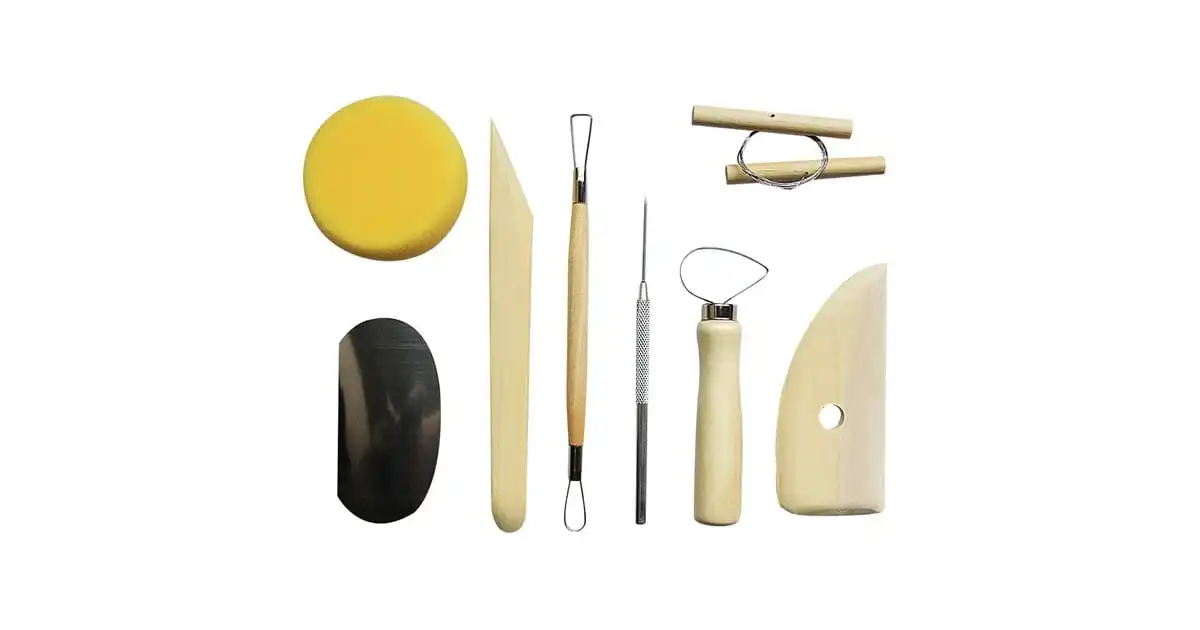
A beginner does not need forty tools. They need eight, chosen so that between them every basic hand-building technique is covered. Buy the eight, learn what each one does, and only then add specialist pieces.
This is the eight-piece base set we ship most often to studios, schools and art-supply retailers — and the reasoning behind each item, so you can judge whether a kit you are looking at is genuinely complete.
The 8-piece base list
1. Wire clay cutter. Cuts a block of pottery clay cleanly and slices a thrown form off the wheel head. Buy one with a wooden toggle at each end; a bare wire cuts into your fingers before it cuts the clay.
2. Wooden modelling tool, double-ended. One end for smoothing, one for shaping. This is the single most-used clay sculpting tool in a beginner’s hand.
3. Loop / ribbon tool. Carves, hollows and trims. Essential the moment a piece needs to be hollowed before firing, and the tool that turns a pottery tool set from a shaping kit into a finishing kit.
4. Needle tool. Scores a surface before joining two pieces of clay and pokes air holes. Cheap, and the tool whose absence causes the most cracked work.
5. Ribbon / scraper (metal or plastic). Compresses a rim, shapes a curve and smooths a wall. Buy two — a flexible and a rigid one.
6. Sponge. Water control is the whole craft. A painting sponge style sponge paired with a sponge brush handles rim wiping and surface finishing; ceramic suppliers often list these under their own category rather than with the clay tools, which is why beginners miss them.
7. Paddle. Firms up a wall and squares a coil pot. The tool that makes a form stop looking soft.
8. Cutting / shaping knife or blade. Trims a foot and cleans a join. In schools it is usually the item that decides the age rating of the whole kit, so specify it deliberately.
Together these cover pinching, coiling, slab building, scoring and joining, and basic wheel trimming. A kit missing the needle tool or the loop tool is not a beginner’s kit — it is a collection of tools.
Choosing between clay bodies: air dry clay vs pottery clay
Two products sit behind a beginner’s first purchase, and they need different tooling.
Air dry clay needs no kiln, so it is the default for classrooms, after-school programmes and home kits. It rewards tools that compress and smooth — ribs, paddles and sponges — and punishes anything that removes too much material at once, because the body is softer and air-dries fast.
Pottery clay for wheel and hand-building work is fired, so trimming and hollowing tools matter more, and the loop tool and wire cutter move from optional to essential. If your shelf stocks mainly air dry clay, spec a clay craft tools set weighted towards shaping; if it stocks wheel clay, weight it towards cutting and finishing.
Polymer clay is a different kit
Polymer clay tools are often shelved next to pottery tools and then sold as though they were the same thing. They are not. Polymer clay is oven-cured and works at a much smaller scale, so the useful tools are mini modelling tools, fine needles, ball styluses and blades — the tools a polymer clay tools professional uses for jewellery and miniature work.
If you are buying for both audiences, treat them as two SKUs, not one. A combined kit usually serves neither: the pottery tools are too big for polymer work, and the mini modelling tools snap when used on dense wheel clay.
What a starter kit should cost you in tooling terms
Buyers evaluating a kit for resale should ignore the piece count and count the techniques covered. Eight tools that cover five techniques beat twenty tools that cover two.
Then check the practical details:
- Material. Stainless steel for needles, wires and blades that touch water; hardwood or dense plastic for ribs and paddles. Our tool lines run on plastic and stainless steel; our clay range includes air-hardening modelling clay in 250 g, 500 g and 1000 g blocks in grey, white and brown.
- Safety rating for school buyers. A school programme needs the paperwork attached to the purchase order, not promised after it. Before you sign off a classroom kit, ask for the report number behind the safety claim. On our side: the soft-pastel range is reviewed against ASTM D-4236 and US CPSC 16 CFR §1500.14(b)(8) (DJ2601263903), and MSDS documentation to UN GHS Rev.7 / OSHA 29 CFR 1910.1200 exists for the paint, sketching-tools and soft-pastel lines (ZTS26010605XRM, ZTS26010604ZRM, ZTS26010603KRM). CPC and EN71 certificates cover the lines that ship into North America and the EU. Send us the destination market and we will forward the matching certificate set.
- Packaging. A loose set loses tools in transit. Individual OPP or PVC bagging, then a printed card, keeps the count right and lets you put your own brand on the front.
- Repeatability. A studio reordering a pottery tool set needs the same tool shapes it had last term. Ask for the model numbers, not just the photos.
FAQ
What is the minimum kit for a complete beginner? Wire cutter, needle tool, loop tool, wooden modelling tool, rib, sponge. Six items. Add a paddle and a blade for classroom work, and you have the eight-piece set above.
Do I need a pottery wheel to use these tools? No. All eight work on hand-built pieces. The wheel adds the wire cutter and trimming tools into constant use, but the kit is not wasted without one.
Can I sell this as one SKU? Yes, and it sells better that way for schools. For art-supply retailers, splitting into a hand-building set and a wheel-trimming set usually lifts basket size.
Why do beginner kits in catalogues look different from each other? Because many are built to a price rather than to a technique list. Count the tools that are functionally duplicated — several near-identical ribs, for instance — before comparing piece counts.
Where to start
If you are assembling a beginner’s shelf — for a studio, a school programme or a retail range — the eight items above are the base. Everything else is an upgrade. Our Yiwu line has been running since 1988 and 20 of those years have been under the Xin Bowen name, so the tool shapes in this list are ones we can reproduce season after season rather than ones we buy in and hope to restock.
Quotation on request. Tell us which items you are stocking, or simply which age group and technique you are buying for, plus the quantity you have in mind. You will receive a factory quotation with the MOQ for each item and the lead time. Prices are not listed on this site — the specification decides the number, and a per-item MOQ is more useful to you than a headline figure anyway.
Samuel Zhao(赵川) · Sales Director · +86 153-3692-1170 (phone & WhatsApp) · pm@tengyuanbrush.com Shop: No. H1-21425-21424, 1st Floor, 1st Street, Gate 53, Third District, International Trade City, Yiwu, Zhejiang, China → Contact us for a quotation