

Three Ways to Count the Same Carton
Take one carton, hand it to three buyers, and ask how many pieces are inside. The first counts brushes and says twenty-two. The second counts brushes and tools and says twenty-four. The third counts everything that ships, including the bag, and says twenty-five.
All three are right. That is the problem. A piece count is not a fact about the carton; it is a definition the seller applies to the carton, and until the definition is on paper the number is a coin flip between three honest answers.
This is not a pedantic distinction. Piece count is the anchor for comparing quotations, for writing a purchase order, and for the inspection that decides whether a shipment is acceptable. Get the definition wrong and every one of those three steps inherits the error.
| Counting convention | What it produces | When it is the right one |
|---|---|---|
| Brushes only | the size of the toolkit | comparing brush quality between suppliers |
| Brushes and tools | the working kit, excluding packaging | costing a complete usable set |
| Everything shipped | every object in the carton | checking a delivery against a purchase order |
What a Piece Is, When the Seller Decides
In a brush set, a piece is any item the seller chooses to count. The choice is legitimate in every direction, but it has to be declared. A set described as twenty-two pieces and shipping with a knife is not short; it is counting differently from the buyer who expected twenty-four.
The useful way to hear a piece count is as a promise about the carton rather than a description of the toolkit. Twenty-five means twenty-five things will be in the box. Whether those things are twenty-five brushes, or twenty-two brushes plus three other objects, is a second question, and it is the one that decides whether the number is useful to you.
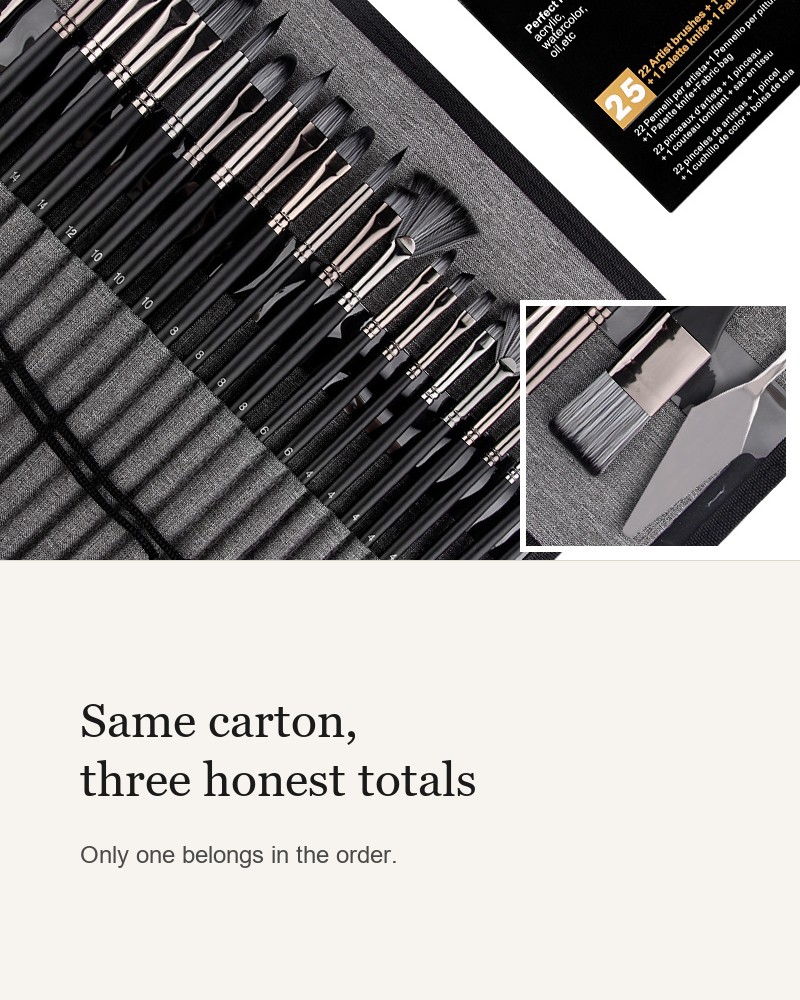
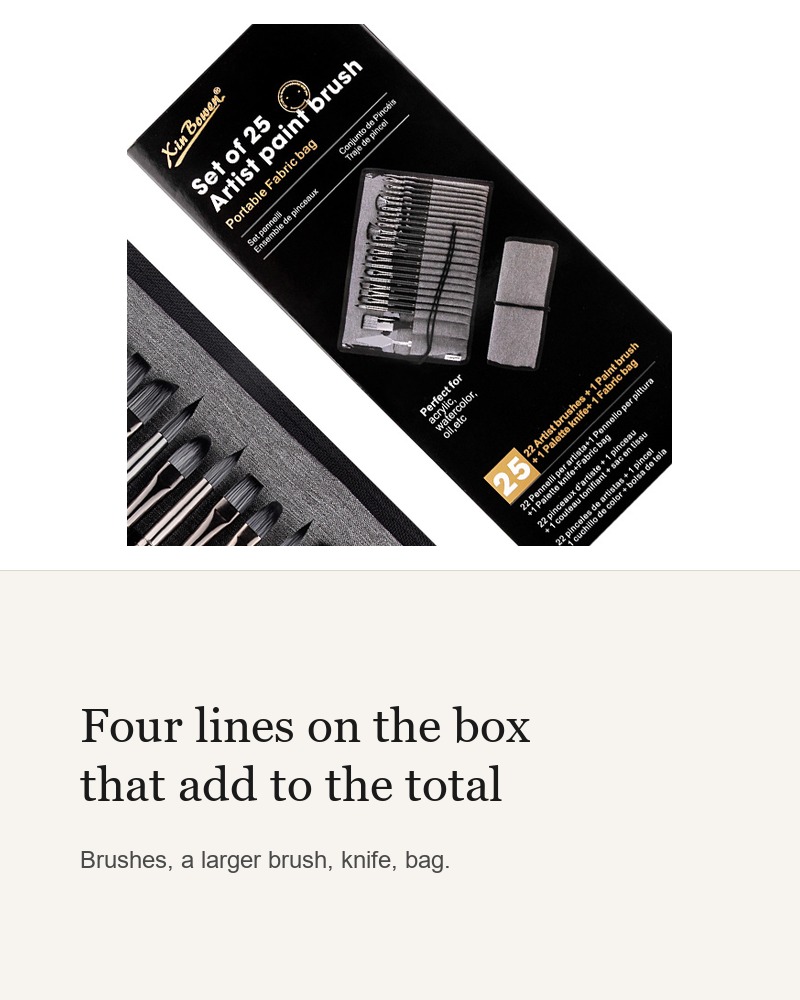
The set used as the example throughout is published with its four-line breakdown, and the arithmetic can be read straight off it: the 25-piece set. Twenty-two artist brushes, one larger paint brush, one palette knife, one fabric bag.
Why the Bag Changes the Arithmetic
The bag is where most of the confusion lives. It is a real object, it ships inside the carton, and it is counted here. A supplier who does not count it will describe the same shipment as twenty-four.
Neither convention is better, and the harm comes from mixing them. Two suppliers quoting “twenty-five pieces” can be one bag apart, and a buyer comparing them on the number alone is comparing a toolkit with a toolkit plus luggage.
There is a simpler test than arguing about which convention is correct. Ask what the count is for. If it is for comparing toolkits, count tools and brushes and leave the bag out. If it is for checking a shipment against a purchase order, count everything in the carton, because that is what will be unpacked and ticked off. Both answers are defensible; only one can be in the document at a time.
This is the same question that decides how a set should be described in the first place: what a set should contain.
Count by Family, Then Add the Tools
A single total hides the failure that matters most. Twenty-five items can be present while one head-shape family is missing entirely, and the total will still read twenty-five.
Counting by family closes that gap. Take the brushes first, sort them into flat, round, filbert, fan and angular, and confirm each family is represented in more than one size. Then add the larger brush, then the knife, then the bag. Four lines, and a total that can be explained rather than asserted.
The family check is also the fastest way to spot padding. A set that reaches a round number by repeating one shape in near-identical sizes will pass a total and fail this count, which is why the two checks belong together. The range page shows how the families are organised across the catalogue: the brush range.
Where the Piece Count and the Cost Stop Agreeing
Piece count feels like a proxy for value, and it is a bad one. Twenty-two brushes across five families, plus a knife, is a more expensive thing to make than thirty flat brushes in thirty consecutive sizes, even though the second number is larger.
The reason is complexity per piece. A fan head and an angular head are separate assembly setups; a run of one shape in thirty sizes is one setup repeated. So a buyer who anchors on count alone will systematically prefer the simpler, cheaper set and then wonder why it cannot do the work.
A quick way to see the shape of a set is to divide the count by the number of distinct head shapes it offers. A low result means many brushes doing similar work; a higher one means a set built for range rather than for volume, and the two are rarely priced alike.
The same logic applies inside the count. A knife is one piece and it is not a small one: a rigid blade, a joint and a handle cost more to make than a middle-size round brush. The rigid tools have their own specification pages for this reason: the palette knife.
What the Box Already States
The retail carton is more informative than most buyers expect, and it is worth reading before the quotation rather than after the shipment. This one states the total, the four-line breakdown, and the media it suits, in four languages.
What it does not state is the blade size of the knife, the length of the handles, or the number of layers in the bag. Those belong to the specification sheet, and expecting them from retail copy is how a buyer ends up with an assumption instead of a number.
Read the box for the count and the media claim. Read the specification for the measurements. When the two disagree, the specification wins, and the disagreement itself is worth raising before the order rather than at goods-in: the company profile.
Five Questions Before You Order
Ask what the count includes, and write the answer as a list rather than a sentence. Ask whether packaging is counted, because one bag is enough to move a total by one. Ask whether tools are counted, and which tools. Ask whether the count is per set or per carton, since a carton of sets multiplies the ambiguity. Ask which document will carry the number, because a count that lives only in a chat message is a count nobody can enforce.
Five questions, five short answers, and the ambiguity that causes most piece-count disputes is gone before the order exists. None of them requires the supplier to change anything; they only require the definition to be stated.
The inspection side is where those answers get tested, and the discipline is the same one applied to any shipment: what buyers should inspect.
Writing the Definition Into the Order
The last step is the one that makes the other four durable. Put the definition next to the number in the purchase order: twenty-five pieces, comprising twenty-two artist brushes, one larger paint brush, one palette knife and one fabric bag.
Once it is written that way, three things become possible. A shipment can be checked line by line instead of by total. A second supplier can be compared on the same basis. And a reorder can be verified against the original, which is where count drift usually appears, quietly, one substituted item at a time.
The set used as the example here is published in more than one colourway, and the breakdown is the same across them: the natural handle version. When the definition needs to be agreed before a quotation, that is a conversation rather than a page: the contact page.
Xin Bowen is a Chinese art-materials manufacturer. Brush lines have been in production since 1988 in Jiangxi; the brand itself was founded in 2008. The company and its distribution operation are based in Yiwu, Zhejiang, and production is carried out at our own plants. We supply brushes, paints, palettes, paper and canvas, sketch series and studio tools, among other art materials, to wholesalers, brand agents, art-supply retailers and school programmes.
Send us the model or the use case, and the quotation comes back item by item — MOQ, carton quantity and lead time included.