
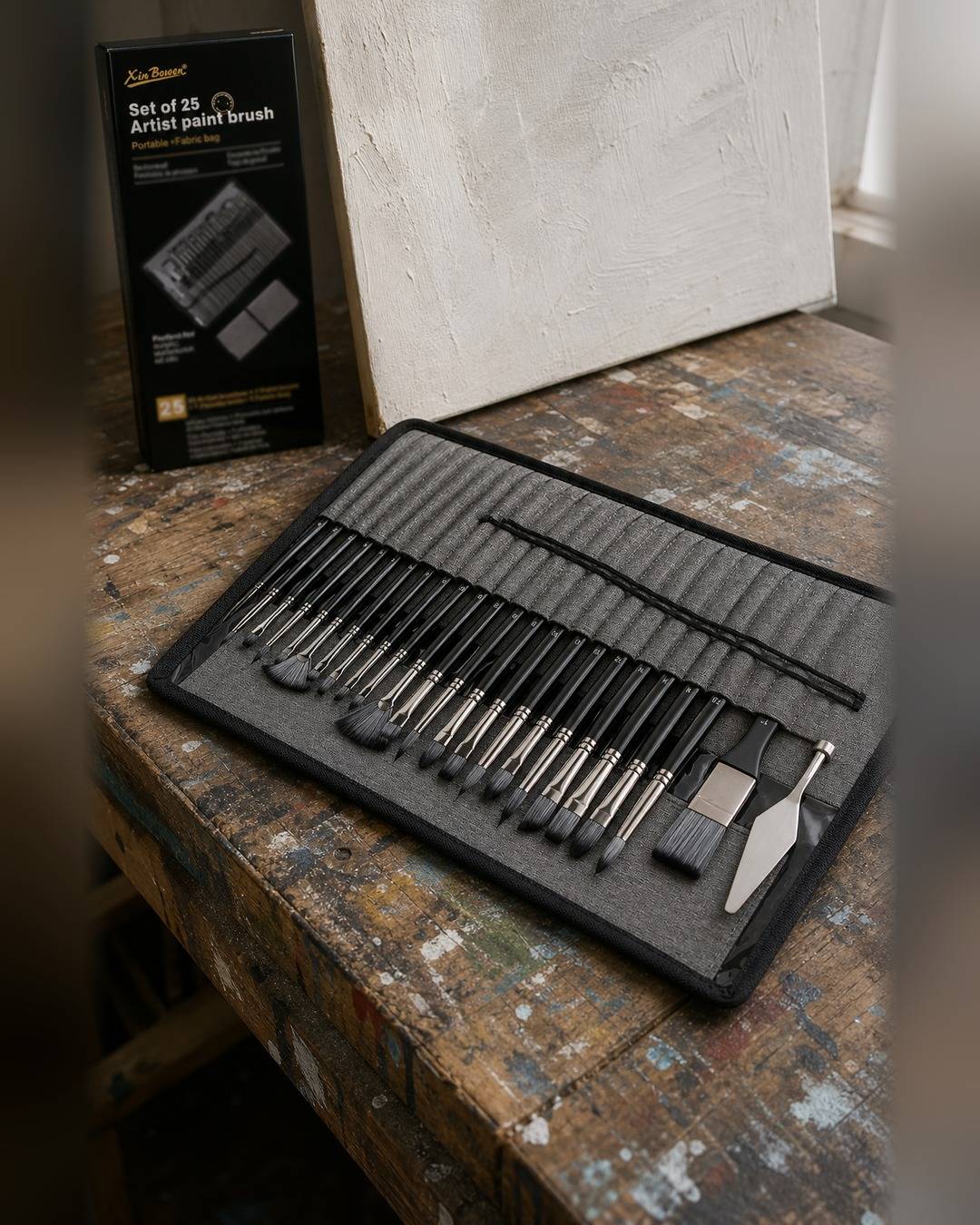
A private label paint brushes order rarely fails at the factory. It fails in the brief.
We see the same pattern from both sides. A buyer sends a reference photo and a quantity. Three weeks later there is a sample that is close but not right, and a conversation about who misunderstood what. The rework was avoidable at the first message.
This is the sequence we run with a new customer buying own brand paint brushes, with the decisions that actually change the quote in each step. It is the ordering side of the question — if you are still comparing suppliers rather than placing an order, the evaluation checklist is the better starting point: https://www.xinbowen.com/one-stop-art-supplies-supplier-oem-odm-evaluation-checklist/
What “custom” covers — four levers, not one
“Custom” is used loosely, and the looseness is what causes most of the back-and-forth. In a brush order — including a custom artist brush run for a single account — it means four independent decisions:
Lever
What changes
What it does to your project
Handle
Custom handle colour, finish, printed logo, printed size numbers
The most visible lever and the cheapest to change
Bristle
Material, stiffness, blend
Decides how the brush behaves; hardest to change late
Shape and size set
Which forms, which widths, how many pieces in the private label brush set
Decides what the set is for, and your MOQ
Packaging
Printed blister card, bag, retail box packaging, printed inlay
Decides shelf presence and adds the most lead time
Treat them as four separate lines in your brief. A supplier who answers one price for “custom brushes” is answering a question you did not ask.
Step 1 — The brief: six lines that replace a week of email
Send these six items and the first quote is usually the final one:
The use case — school, studio, craft, paint-by-numbers, own brand.
The shapes and widths you want, or the set you already sell (a photo plus a model number works).
The bristle you want, or the destination market and we will propose one.
The packaging format and whether it carries your brand.
The quantity, even if it is a trial quantity. A trial number produces a usable quote; a range does not.
The destination country, because it decides which documents ride with the shipment.
Anything you leave out becomes a question in week two. That is the whole cost of a thin brief.
Step 2 — MOQ, and what actually moves the number
There is no factory-wide MOQ. Every MOQ paint brush question we get comes down to four reasons:
Colour count. A printed item in one colour and the same item in four colours are not the same run.
Bristle and ferrule spec. A standard ferrule you already run and a new ferrule are different projects.
Packaging format. A plain polybag and a printed retail box sit in different processes.
Whether the tooling exists. New dies and new moulds carry their own lead time and cost.
Two practical points that shorten a first order:
Cartons, not units. Ask for the carton quantity next to the MOQ. You are planning a container, not a shelf.
A small first run beats a large discount. If the line is new to your market, prove the shelf first. Ask for a trial quantity and be explicit that a repeat order follows a good first shipment — that is a normal conversation, and it is the reason small-batch customisation is worth asking for.
Every MOQ we quote comes with the carton quantity and the lead time attached, per item.
Step 3 — Sampling: what each sample proves, and what it cannot
Brush sampling runs in three stages, and each one answers a different question.
Sample
What it proves
What it cannot prove
Stock sample
The shape, size and feel of an existing reference
Nothing about your branding, printing or packaging
Pre-production sample
Your handle colour, your print, your set composition — the actual item
That the packing line will repeat it at volume
Print proof
The logo position and the colour on the real substrate
The bristle, the ferrule or the set composition
For a custom logo paint brush, ask for a printed proof on the real handle — not a photo of a printed handle. Colour behaves differently on a lacquered handle than on a screen, and the difference is exactly what gets rejected at goods-in.
Two terms worth fixing in writing before sampling starts: what the sample costs, and whether it is credited back against the first order. Bespoke samples carry a sample production charge; stock samples carry a sample fee. Both are normally returnable on a confirmed order, and a supplier who will not state the terms plainly is showing you how the order will run.
Step 4 — Artwork and print: positions and limits
Most disputes on a custom paint brush with logo printing are about position, not colour. Specify in the brief:
Where the logo goes — handle barrel, packaging face, or both.
How many print positions per piece.
The colour limit on that surface, and whether the print is one colour or a registered multi-colour job.
The smallest legible size on the surface you have chosen.
Our stock range prints standard size numbers on the barrel as part of the item. That is a production feature, not a customisation: if you want your own numbering scheme instead, say so in the brief, because it changes the print run.
Step 5 — Packaging: four formats and their trade-offs
Custom brush packaging is the step where lead time is won or lost. The four formats we run most often, in ascending order of lead time:
Polybag — fastest, lowest cost, no shelf presence. Right for a trial and for e-commerce singles.
Blister card — the format that carries the information at the point of sale: shapes, count, declared use. This is what converts on a pegboard.
PVC bag with card — a hanging format that shows the product through the packaging. Common where the buyer needs to see the brush before buying.
Printed retail box, printed inlay, or fabric roll — the highest perceived value and the longest lead time, because the box and the inlay are separate print items.
Two decisions inside this step that buyers routinely forget:
The language on the front face. Spanish for Latin America, Portuguese if Brazil is in scope, English for North America. One card, one language is cheaper than a multi-language card, and it sells better in each market.
The declared use on the front face. A card that says “acrylic and oil” outsells a card that says “brushes”. The buyer self-selects on the shelf instead of asking.
A note on mixing formats: packing one purchase order across two formats is possible, and it is usually the reason a carton count stops adding up. Fix the format per item before the PO, not after.
Step 6 — Lead time, cartons and the documents that travel with the order
Lead time is a capacity question in disguise. If you are sourcing as a wholesale artist paint brush buyer, ask for the monthly output of the line you are actually using — not of the factory — and compare it with your forecast.
What we state up front, per item: the MOQ, the carton quantity, and the production lead time. What goes with the shipment: multi-layer cartons, the inspection record, and the document set that matches your destination market.
Documents on request, with reference numbers rather than a badge:
MSDS for the paint, sketching-tool and soft-pastel lines.
ASTM D-4236 review on the soft-pastel range — reference DJ2601263903.
Bureau Veritas SDS — reference (9126)023-0315.
Three ZTS reports — references ZTS26010605XRM, ZTS26010604XRM, ZTS26010603KRM.
CPC / EN71 for the lines shipping into North America and the EU.
If you need the numbers for a specific destination, ask with the market named and you get the file, not a photograph of it.
Who we are
Xin Bowen is a Chinese art-materials brand founded in 2008, and a paint brush manufacturer in China with more than three decades on the same product line. Brush production goes back to 1988 at our Jiangxi factory. The company and its distribution operation are in Yiwu, Zhejiang, with supply origins in Nanchang (Jiangxi) and Yangzhou (Jiangsu). We run three factories, one of them our art-pigment plant in Ningbo, across 65,000 m² of factory space.
The capacity figures we quote apply to the brush lines only: 13 in-house designers and more than 100,000 brushes per month per brush line.
How we quote
No prices are published, on purpose. A brush set and a printed retail box do not share a costing model, and the honest number depends on your brief — colour count, bristle, set composition and packaging.
Send the six-line brief and you get back three numbers per item: MOQ, carton quantity and lead time, plus the certificate set that covers the line.
Write to us here: https://www.xinbowen.com/contact-us/
Or directly to Samuel Zhao, Sales Director
pm@tengyuanbrush.com
+86 153-3692-1170 (phone and WhatsApp)