

Gesso Brush vs Paint Brush: Which One Actually Primes a Canvas
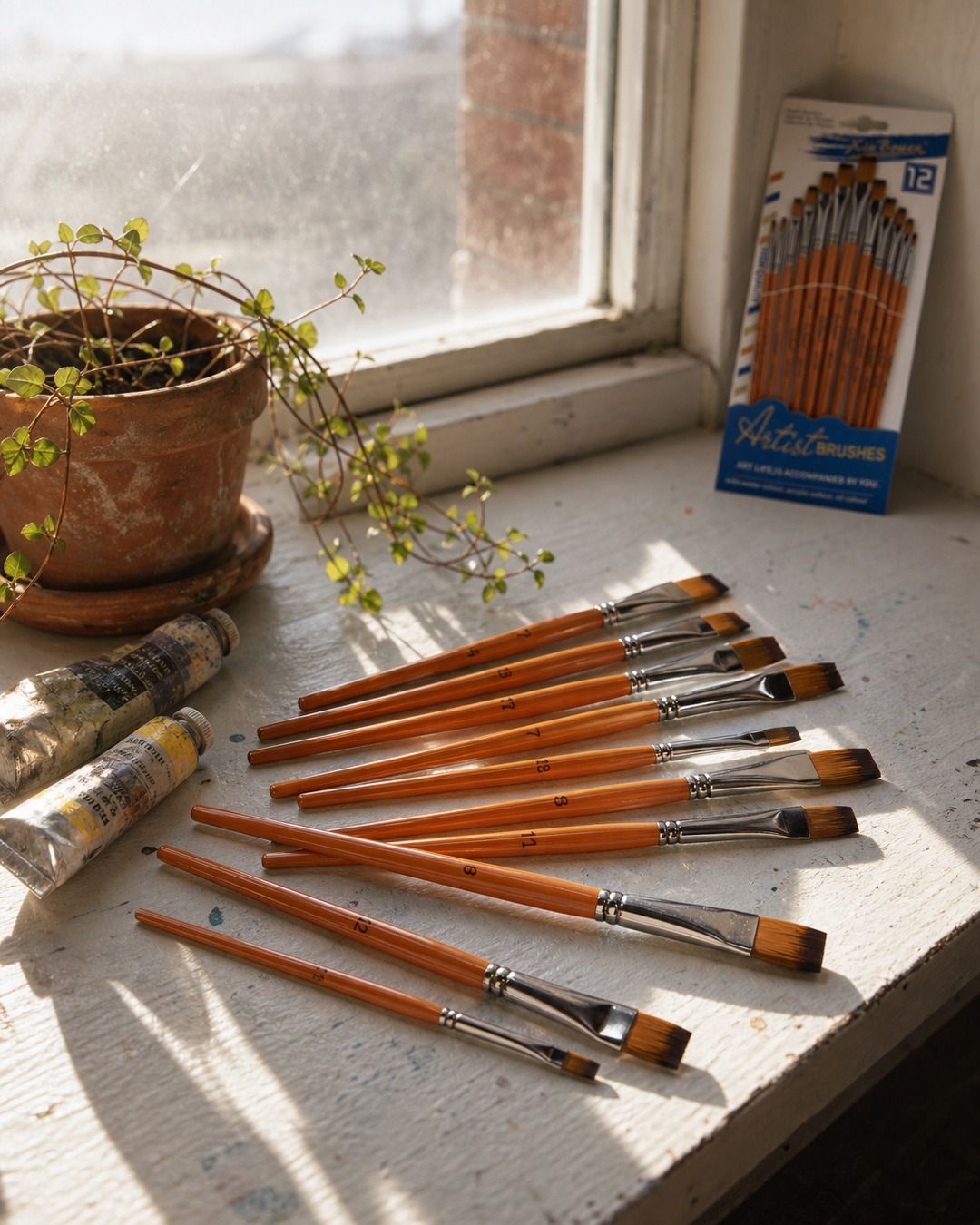
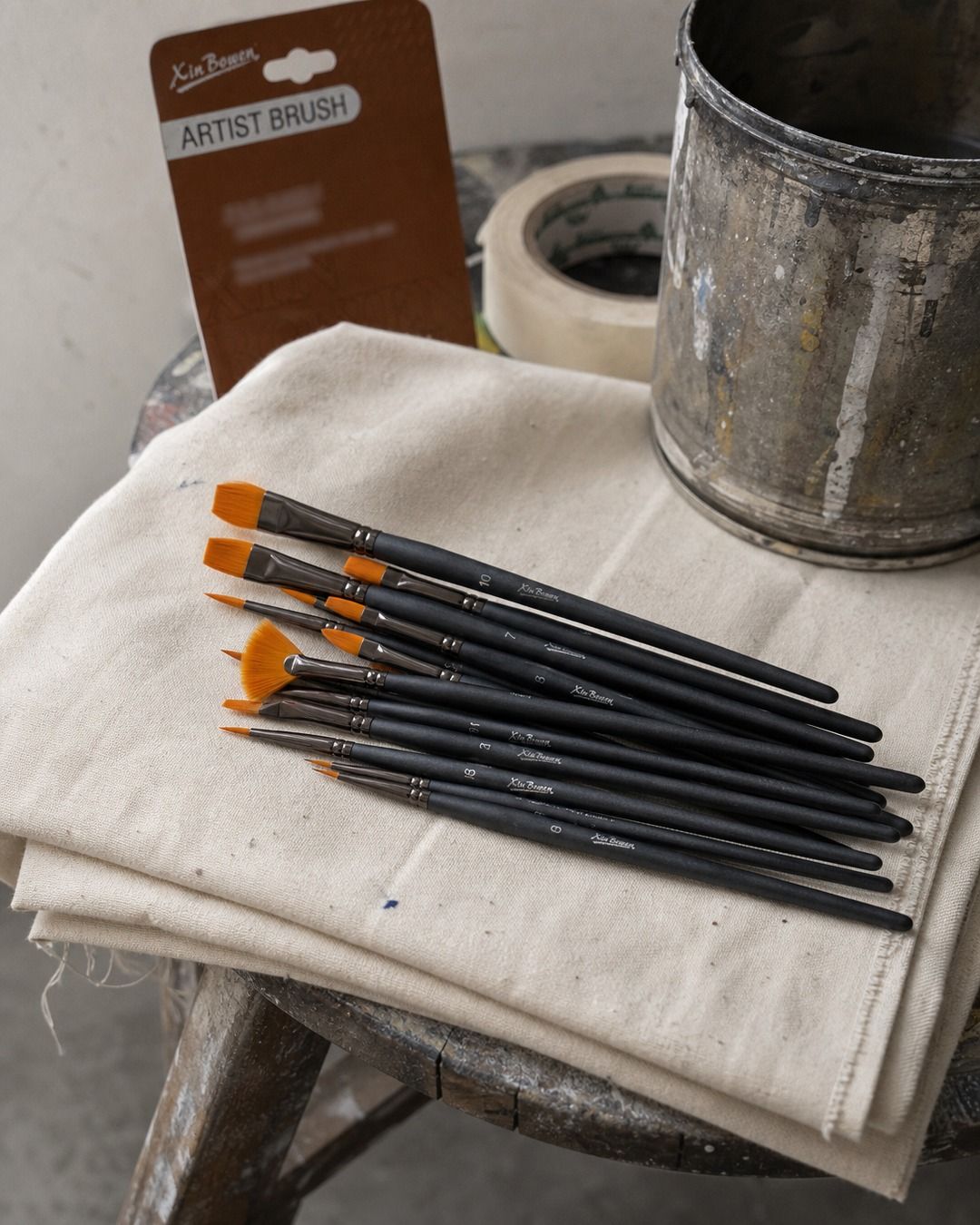
A gesso brush and a paint brush look like cousins on a shelf and behave nothing alike in the hand. One is built to push a heavy, abrasive primer into an open weave and survive it. The other is built to place pigment precisely and keep a point.
Using the wrong one does not ruin the painting. It ruins the first 20 minutes — brush marks you have to sand out, bristles you have to pick out, and a coat that dries unevenly and shows through the finished piece.
Here is what actually separates the two, and how to choose by canvas size instead of by habit.
## What a gesso brush actually is
A gesso brush is a wide, stiff, short-handled brush sized in millimetres rather than in artist sizes. It is not a “primer brush” in the hardware sense either — hardware sash brushes are built for oil-based paint on timber and their bristle is usually too coarse and too long for canvas.
Three things define it:
– **A wide flat head.** Gesso brush sizes run from 20 mm to 60 mm, and the head is flat — not filbert, not round. The head is flat, not filbert and not round.
– **Dense, springy bristle.** Synthetic (nylon) or hog. Dense enough that one pass loads a strip, not a line.
– **A short handle.** You work with the palm down and the wrist stiff, close to the surface, because gesso is applied flat and fast.
Some suppliers list the same tool as a canvas priming brush or a primer brush. It is one shape under three names.
So, what is a gesso brush? A wide flat synthetic or hog brush, 20–60 mm, short handle, built to load and spread primer across a surface.
## Gesso brush vs paint brush: the three differences that matter
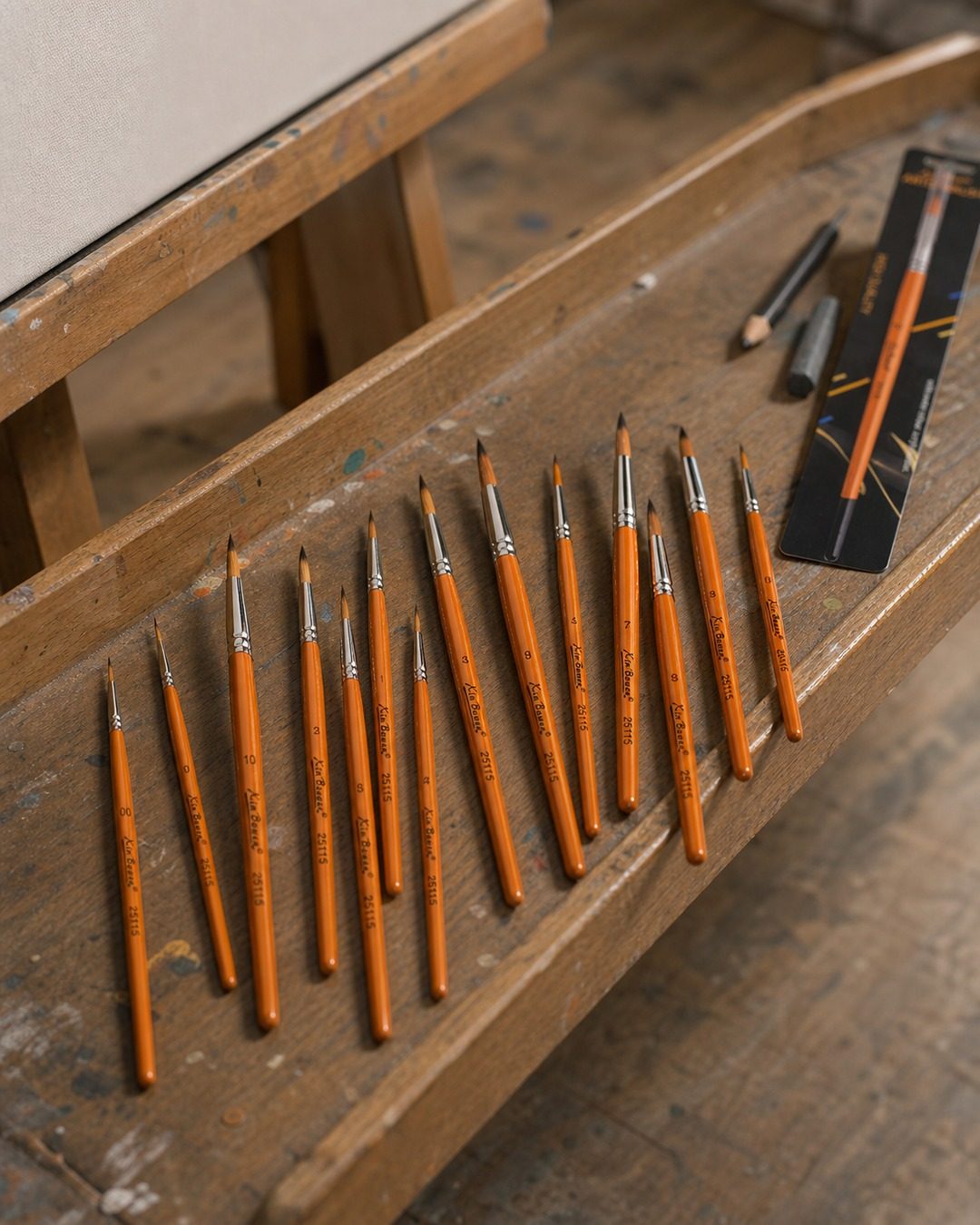
**1. Bristle stiffness and density.** A priming brush trades point for load. A paint brush trades load for point. That is the whole trade. A soft round watercolour brush will apply gesso — badly, in narrow streaks, and it will splay within one coat.
**2. Ferrule construction.** This is the difference most buyers never check and the one that produces the complaint “the gesso brush sheds”. A priming brush is pushed hard, flat against a textured surface, over and over. The ferrule therefore has to be crimped tighter and the bristle has to be anchored with cured adhesive at the base, not just set into the cup. On a cheap brush the bristle is glued on the outside of the plug, and the first hard pass pulls it free.
**3. Bristle length.** Priming bristle is cut shorter relative to head width than a paint brush of the same width. Short bristle resists splaying under pressure, which is what keeps a 50 mm brush usable after fifty canvases.
## Which brush for which primer
The best brush for applying gesso is the one matched to the primer, not to the canvas.
**Acrylic gesso (the default).** A synthetic gesso brush — nylon flat — is the right answer for most studios. It does not swell the way hog does, it cleans in water, and it leaves a slightly finer tooth. This is the right answer for most studios.
**Oil-based primer.** A hog bristle gesso brush, because the stiff flag tips work the primer into the weave and hog tolerates solvent cleaning. A nylon brush will work but ages faster.
**Clear gesso and tinted gesso.** Synthetic flat, and keep it separate from your white-gesso brush. Tinted gesso in a white brush is a slow way to ruin a good brush.
**Heavy texture and tooth.** Hog, and expect to sand between coats.
**Fast, mark-free coverage on large pieces.** Foam roller vs gesso brush: the roller lays primer flat but compresses the weave slightly, so most painters finish the edges with a flat brush. Roller in the middle, brush on the edges is the working compromise.
## Width by canvas size
Wider canvas is not always a wider brush — past a point a wide brush on a small panel just wastes primer. This is how we size a flat brush for priming canvas.
| Canvas width | Working brush | Why |
|—|—|—|
| Up to 30 cm / 12 in | 20–30 mm flat | Control beats speed at this size |
| 30–75 cm / 12–30 in | 40–50 mm flat | One pass covers a full vertical strip |
| 75–150 cm / 30–60 in | 50–60 mm flat | Fewer overlaps, so fewer visible ridges |
| Over 150 cm / 60 in | 60 mm flat + roller | Roller for the field, brush for the edges |
Two working rules that come out of that table:
– **Apply the second coat at 90° to the first.** The cross direction is what makes the tooth even.
– **Do not overwork wet gesso.** Each extra pass lifts primer and leaves a ridge. Lay it down and leave it.
## Gesso brush shedding is usually the ferrule, not the bristle
When a priming brush sheds, the instinct is to blame the bristle. In practice the failure is almost always at the join: bristle anchored only on the outside of the plug, adhesive applied cold, or a ferrule crimped loose enough that the plug moves inside the cup. Once the plug can move, bristle works free every pass.
A pull test catches it before you order: take a pinch of bristle right at the ferrule, pull firmly. A properly anchored brush gives up one or two strands. A badly anchored one gives up five or six, and it will keep doing it.
## Cleaning and how long a gesso brush lasts
Gesso is abrasive and it sets hard. Two habits decide the life of the brush:
– **Rinse in water before the gesso dries.** Once acrylic primer cures inside the heel, the bristle is mechanically locked and the brush loses its flex permanently.
– **Work the rinse to the base, and dry flat or head-up.** Standing a wet brush on its tip curls the bristle and destroys the flat edge you bought it for.
A synthetic priming brush used this way covers 40 to 60 canvases before its edge softens. A cheap one, used the same way, gives up around ten — and sheds through most of them.
## Sizing up a volume order
If you are specifying a wholesale gesso brush line, four points decide whether it is worth repeating:
1. **Millimetre widths stated on the packaging.** A buyer replacing a 50 mm brush needs to find 50 mm again without measuring.
2. **Ferrule metal.** Nickel-plated steel is the working standard; untreated steel marks the handle and the panel.
3. **Handle length by channel.** Studios accept a longer handle; schools and classrooms usually prefer short, because it survives a sink and a shared drying rack.
4. **Weight consistency between cartons.** A brush that feels lighter than the last batch has less bristle in it, whatever the label says.
Gesso paint brush is the name the same tool carries on most wholesale price lists. Our own line runs 20 / 30 / 40 / 50 / 60 mm flat, nylon, wood handle, plus a short blue-handle 3-inch type — catalogue references rather than one-off items, so a repeat order matches the first one. You can see the range here: https://www.xinbowen.com/product-category/paintbrush/gesso-paint-brush/
## Where we sit in this
Xin Bowen is an art-materials brand founded in 2008. Brush production goes back to 1988 at our factory in Jiangxi, and our brush lines are still the origin of what we sell. The company and its distribution operation are in Yiwu, Zhejiang, with supply origins in Nanchang (Jiangxi) and Yangzhou (Jiangsu); we operate three factories, one of them an art-pigment plant in Ningbo.
Design capacity is specific to the brush lines: 13 in-house designers and more than 100,000 brushes per brush line per month — which is why a gesso brush that works in the first carton still works in the fifth.
Paperwork is issued with reference numbers, not badges: MSDS documentation on request, an ASTM D-4236 review on our soft-pastel line (reference DJ2601263903), CPC / EN71 for lines shipping into North America and the EU, a Bureau Veritas report (reference (9126)023-0315) and three ZTS reports (ZTS26010605XRM, ZTS26010604XRM, ZTS26010603KRM).
## Getting a number on your list
We do not post prices — the figure depends on the specification, and a quote built from a catalogue page is a quote you have to redo. Send us four things and you get an exact figure back:
1. **Widths and quantity** you want per width.
2. **Bristle**: synthetic, hog, or your market and we will recommend.
3. **Handle and presentation**: short or long, plain or printed, bulk or carded.
4. **Destination market**, so the certificate set is right the first time.
You will get the MOQ per item, the carton quantity and the production lead time, plus the certificate set that covers the line.
Start here: https://www.xinbowen.com/contact-us/
Or reach Samuel Zhao (赵川), Sales Director
pm@tengyuanbrush.com
+86 153-3692-1170 (phone and WhatsApp)